Why Meal Planning for Weight Loss Isn't Optional
Let's cut through the noise.
If you're serious about sustainable weight loss, meal planning isn't a nice-to-have — it's non-negotiable.
And the research consistently backs this up.
A 2017 study published in The International Journal of Behavioral Nutrition and Physical Activity found that individuals who planned their meals were significantly more likely to eat a healthier, nutrient-dense diet — and had a meaningfully lower risk of obesity.
That's not just correlation. That's strategy in action.
Here's the thing most diet advice gets completely wrong: weight loss isn't a motivation problem. It's a systems problem. And meal planning is the system that solves it.
The Real Reason You're Struggling (It's Not Willpower)
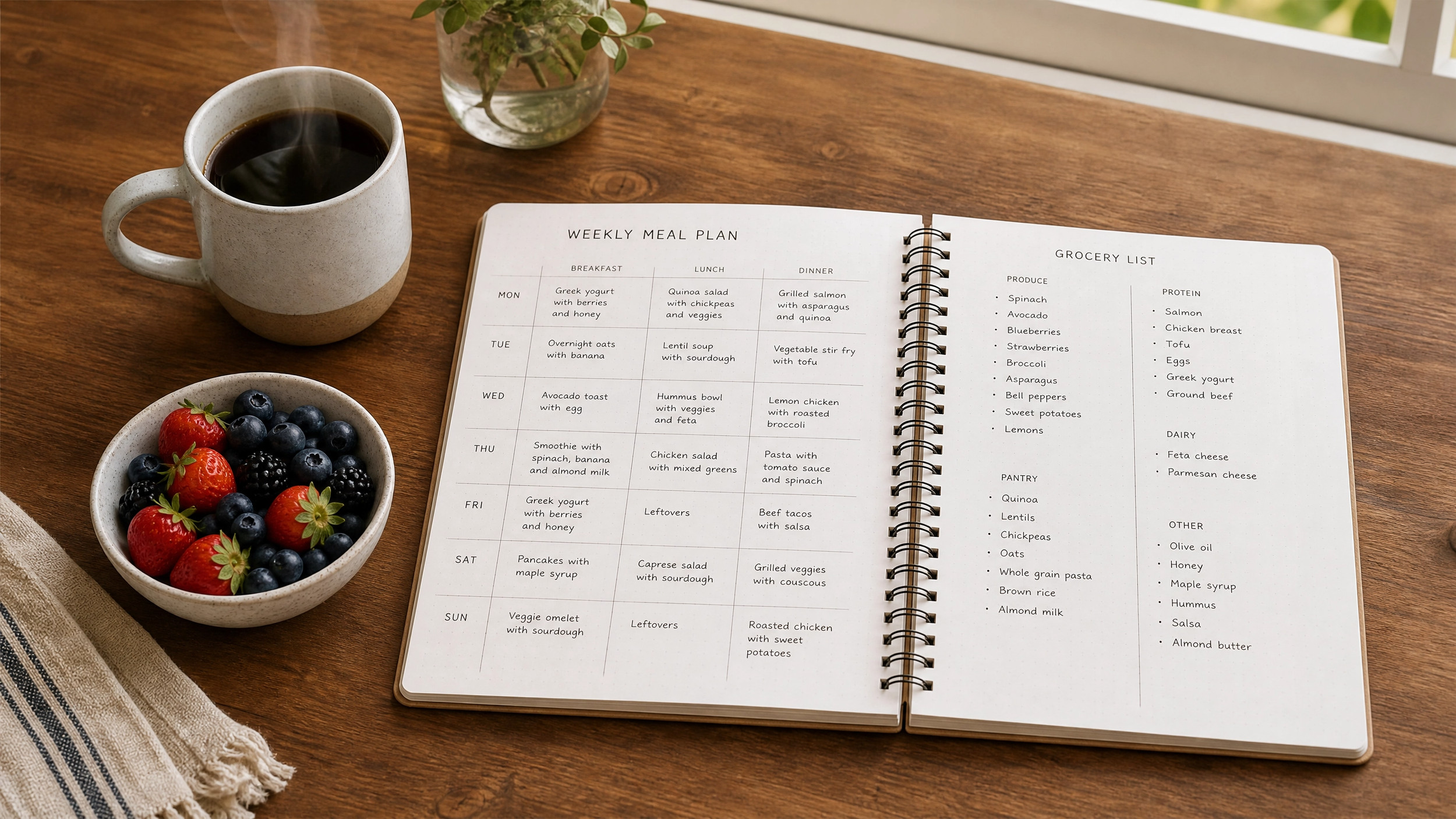
You're a purpose-driven woman. You manage a career, a family, a home, and probably the emotional needs of everyone around you. You are not lazy. You are not undisciplined.
You're just trying to make food decisions on the fly — in the margins of an already full life. And that approach will fail every single time, not because of who you are, but because of how your brain works.
Here's what actually happens on a typical weekday:
You skip breakfast because you're rushing out the door. You work through lunch because a meeting ran long. By mid-afternoon, you're running on empty, stress is high, and your decision-making is depleted. And then comes dinner — where you're standing in front of the fridge at 6pm, exhausted, with no plan.
Sound familiar?
This is what researchers call decision fatigue — the well-documented phenomenon where the quality of your decisions deteriorates after a long session of decision-making. By evening, your brain is done choosing wisely. It just wants easy and immediate.
Meal planning removes you from that equation entirely.
When your meals are already decided, there's no decision to fatigue. There's just execution. And execution — even imperfect execution — is what creates results.
5 Practical Meal Planning Strategies for Busy Women
These aren't strategies for someone with a meal prep Instagram account and four free hours on Sunday. These are strategies for real life — your life.
🧠 1. Plan Once, Eat on Autopilot
You already know how to plan. You do it at work. You do it for your kids. You do it for your social calendar. The skill is not the problem — the application is.
Failing to plan is planning to fail. That might sound blunt, but it's also freeing: you already have everything you need to do this.
Try this: Block 30 minutes each weekend — Sunday morning with your coffee works well — to map out your most stressful meals. Not every meal, just the ones where you consistently lose ground. Which meals are hardest to decide? Which ones tend to derail you? Plan those first. Then make your grocery list from that plan.
That single 30-minute investment can save you hours of reactive scrambling — and hundreds of impulsive calories — throughout the week.
🥗 2. Rotate 3–5 Default Meals
Here's a truth your Instagram feed won't tell you: you don't need a new recipe every day.
Look at what you already eat. Chances are, you're already rotating through a fairly short list of meals anyway — just not intentionally, and not always the healthiest ones.
The goal isn't to turn your kitchen into a restaurant. It's to have 3–5 solid, satisfying meals you enjoy, can make without thinking, and can rotate throughout the week. This builds rhythm, reduces food anxiety, and eliminates the exhausting question: "What am I even going to eat?"
Think of it like a capsule wardrobe for your meals. A few reliable staples that work, mix, and match — instead of endless novelty that creates stress.
Start here: Write down 3 dinners you already make that are reasonably healthy and that your household actually enjoys. Those are your default meals. Build from there.
📦 3. Batch Cook Base Ingredients (Not Full Meals)
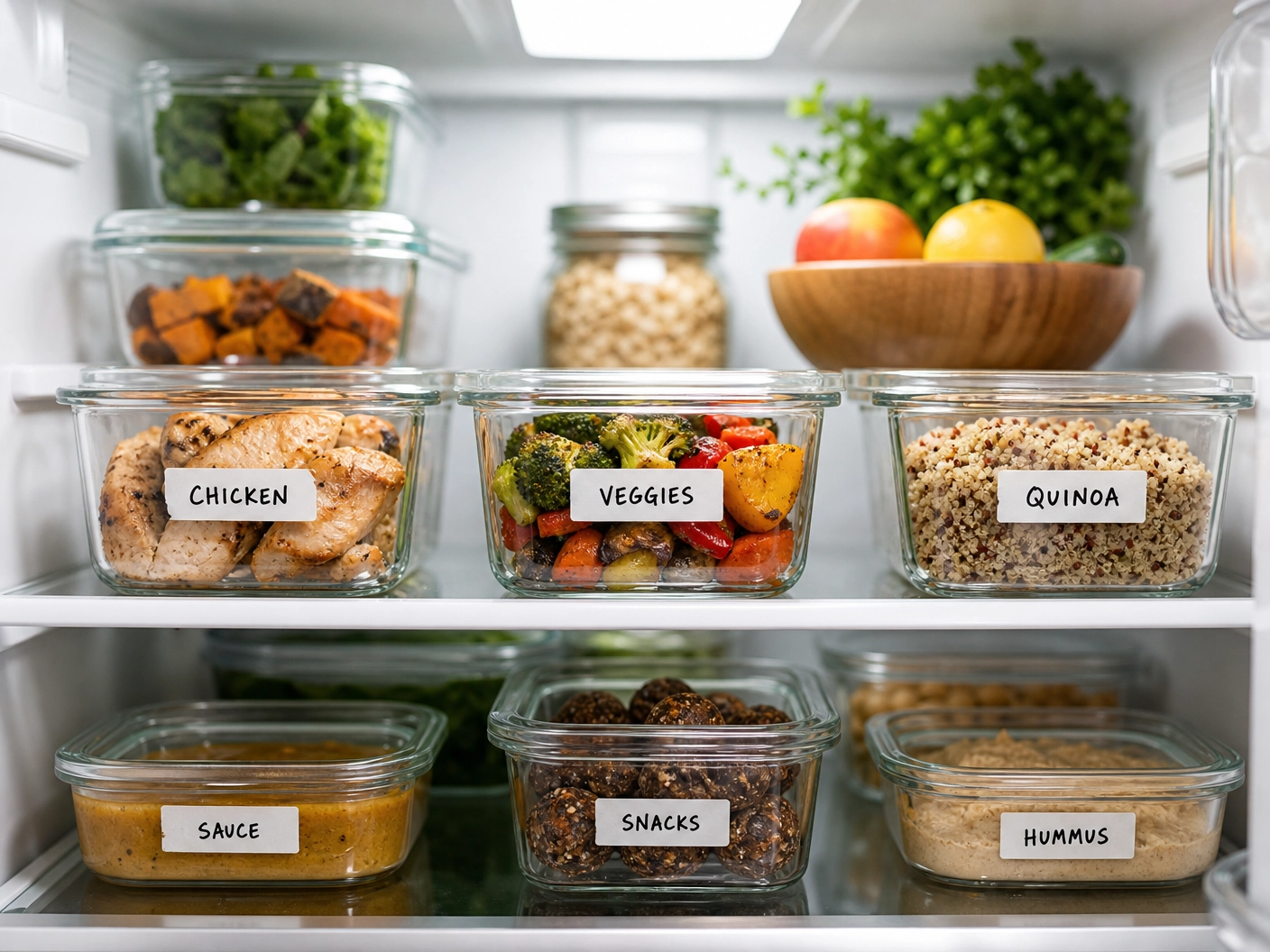
When people hear "meal prep," they picture rows of identical plastic containers lined up in the fridge. And honestly? That's a deterrent, not a motivator.
Here's a better way to think about it: a flexible ingredient bar, not a rigid meal assembly line.
Think about a Chipotle bowl. What makes it work? A protein, a base, toppings, a sauce. Everything is prepped separately. You assemble what you want, in the portions you want, when you want it.
You can do this at home.
Pick 2 proteins (grilled chicken, ground turkey, hard-boiled eggs, canned salmon — whatever works for you). Roast or steam 2 vegetables. Cook 1–2 smart carbs like quinoa, sweet potato, or brown rice. Store everything separately in the fridge.
Throughout the week, you mix and match. One night it's a grain bowl. The next it's protein and veggies over greens. The ingredients stay fresh. The meals stay varied. And you never have to start from scratch.
This is flexible structure — not rigid rules.
📱 4. Use Your Calendar for Your Health
You live by your calendar. You schedule meetings, school pickups, workouts (sometimes), and deadlines. Your calendar is where your life actually happens.
So why isn't your health on it?
Literally schedule your meal planning and prep sessions. Put them in your calendar like appointments, because that's exactly what they are — appointments with the version of you who shows up consistent, energized, and on track.
When it's on the calendar, it becomes a commitment instead of an intention. And intentions rarely survive contact with a busy week.
Bonus move: Schedule lunch on your calendar too. Especially on your most packed days. One of the biggest unspoken patterns in women who struggle with evening overeating is that they've simply forgotten to eat during the day. A calendar reminder solves that.
Your health is a priority. It just needs the same structure you give everything else that matters.
📉 5. Measure Backwards, Not Forwards
Most people set forward-looking goals: "I'm going to eat healthy five days this week." And when that doesn't happen perfectly, they feel like failures and abandon the plan.
Try this instead: measure backwards.
At the end of each week, simply count how many days you actually followed your plan. Don't grade it on a curve. Don't rationalize. Just note the number.
That number is data, not judgment. It tells you where your plan is working and where it needs adjustment. Three out of seven? What happened on the other four days? Was it travel? A hectic Wednesday? Lack of groceries?
This kind of honest, non-punitive reflection builds the self-awareness that makes your plan progressively more effective. You're not chasing perfection — you're building a feedback loop.
And feedback loops, not motivation spikes, are what create lasting change.
What Happens When Meal Planning Becomes Your Default
This is the part that doesn't get talked about enough.
When planning becomes your baseline — when it's just what you do — something shifts. Not dramatically. Not overnight. But consistently.
✅ Hunger stops catching you off guard.
✅ Stress stops pulling you off course.
✅ Cravings lose their grip — because they thrive in chaos, and you've removed the chaos.
You stop white-knuckling your way through the week and start operating from a place of quiet confidence.
I know what I'm eating. I have what I need. I'm covered.
That's not willpower. That's infrastructure.
Meal planning isn't glamorous. There's no viral moment in prepping a pot of quinoa on a Sunday afternoon. But in fat loss, consistency always beats intensity. The person who eats well seven days a week because they planned for it will always outperform the person who ate perfectly for three days and then spiraled on day four.
The Bottom Line
You don't need a perfect diet. You don't need a new meal plan every week. You don't need to love cooking or become a nutrition expert.
You need a system that works in your real life — with your real schedule, your real energy levels, and your real responsibilities.
Meal planning is that system. It's been proven. It's practical. And it's simpler than you think.
Start with one step this week. Plan your most stressful meals. Block the time. Batch two or three ingredients. And watch what happens when your health finally gets the same intentionality as the rest of your life.
Your Next Step
If you're ready to stop guessing and start building a nutrition plan that actually fits your life, let's talk.
I work specifically with purpose-driven professional women who are tired of doing all the right things and still not seeing results — because the issue usually isn't the food. It's the system.
No pressure. No pitch. Just a real conversation about where you are and what's actually getting in the way.